%20(1).jpg)
Prefab ADU Colorado: The Complete Guide for Colorado Homeowners (2026)
You own the house. You've got the backyard. And somewhere in the back of your mind, an idea keeps surfacing — a little studio for your mom, a rental unit that covers the mortgage, a proper home office that's actually separate from the house.
That idea has a name. It's an ADU. And in Colorado right now, there has never been a clearer path to building one.
This is the complete guide — what an ADU is, whether your property qualifies, how Colorado's 2024 law changed the rules, what things cost, how feasibility works, what setbacks mean by city, how homeowners actually finance these things, what the build process looks like step by step, and what makes a prefab ADU different from everything else on the market.
What Is an ADU?
An Accessory Dwelling Unit is a self-contained home on the same lot as your primary residence. Its own entrance. Its own kitchen, bathroom, and sleeping space. Fully independent — just a short walk from your back door.
You might have heard them called granny flats, in-law suites, backyard cottages, or carriage houses. The names vary by region. The thing is the same: a complete, legal, second home on land you already own.
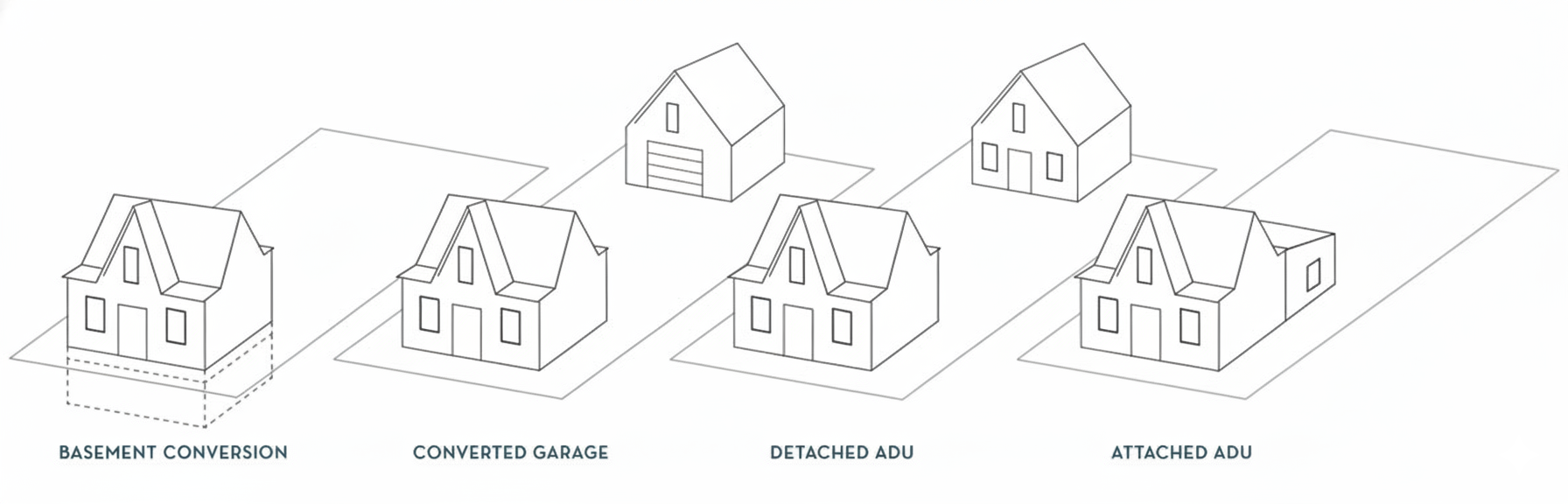
ADUs in Colorado come in three forms:
Detached ADU — a standalone structure in the backyard. Maximum privacy. Maximum rental value. What ELMNTL builds.
Attached ADU — shares a wall with the primary home. Lower construction cost, less physical separation. Works well when lot space is tight or when architectural integration matters.
Garage or basement conversion — transforming existing square footage into a proper living unit. Often the lowest entry cost, but limited by what the existing structure allows: ceiling heights, existing plumbing rough-ins, structural conditions.
For homeowners whose primary goals are rental income or long-term property value, a purpose-built detached ADU consistently delivers the strongest return. You're not retrofitting a compromised space. You're building something right, from scratch.
Colorado's ADU Laws in 2026: What Actually Changed
For years, the biggest obstacle to ADUs in Colorado wasn't desire — it was a patchwork of local rules that varied by municipality, moved slowly, and often said no without good reason.
That changed in 2024, and the effects are now fully in place.
HB 24-1152: The Statewide Shift
Colorado House Bill 24-1152 passed in 2024 and went into effect June 30, 2025. It's the most significant statewide change to ADU rules in Colorado's history.
Here's what it actually does:
- Eliminated minimum lot size requirements for ADUs in most residential zones. Properties that were previously disqualified simply because they didn't hit a square footage threshold are now eligible.
- Required "subject jurisdictions" to allow ADUs by right in all zones where single-family homes are permitted — meaning no special permit or variance process, just standard building approval.
- Who is a "subject jurisdiction"? Cities or towns with 1,000+ residents inside a Metropolitan Planning Organization (MPO), and unincorporated county areas within an MPO that fall in a Census Designated Place with 40,000+ residents. This covers the entire Front Range — Denver, Boulder, Fort Collins, Colorado Springs, and surrounding suburbs.
- Non-subject jurisdictions (rural areas, small towns outside MPOs) still set their own ADU policies, which vary widely.
The practical result: if you own a home in the Denver metro, Boulder County, Larimer County, or El Paso County, you are almost certainly eligible to build an ADU right now. The law didn't just make it easier. It made it the default.
Denver's December 2024 Reform
Denver went beyond the state law. In December 2024, the city legalized ADUs across all residential neighborhoods citywide — not just the areas covered by HB 24-1152, but every single residential lot. Before this change, roughly 30% of Denver properties could support an ADU. After: over 70%.
Denver's historic neighborhoods — deep lots, alley access, carriage house traditions — were already well-suited for ADUs. The zoning just caught up.
The Denver ADU Pilot Program remains active, offering design and permitting assistance plus potential grants for homeowners renting at below-market rates.
What This Means for Your Property
Before 2025, the first question was "am I even allowed?" Now that question is largely settled. The work is in understanding your specific site conditions: setbacks, utility access, HOA rules, and local design standards. That's the actual path now — not a policy fight, but a planning exercise.
Does Your Property Qualify? Four Things to Assess First
Before designing anything, spend time on feasibility. This is where most homeowners lose months — they fall in love with a layout, then hit a constraint that requires starting over. Get clear on these four things before you spend a dollar on design.
1. Lot Size and Shape
The state minimum lot size requirement is gone for subject jurisdictions. But your local municipality may still have its own rules. Denver allows detached ADUs on lots as small as 3,000 square feet. Boulder and Fort Collins vary by zone.
Beyond size, shape matters. A narrow or irregular lot affects where a detached structure can sit while still meeting setbacks on all sides. A slope or existing outbuilding (garage, shed, workshop) changes the foundation approach and access strategy. Tight sites rarely make a build impossible — they just require a more thoughtful layout response.
2. Setbacks
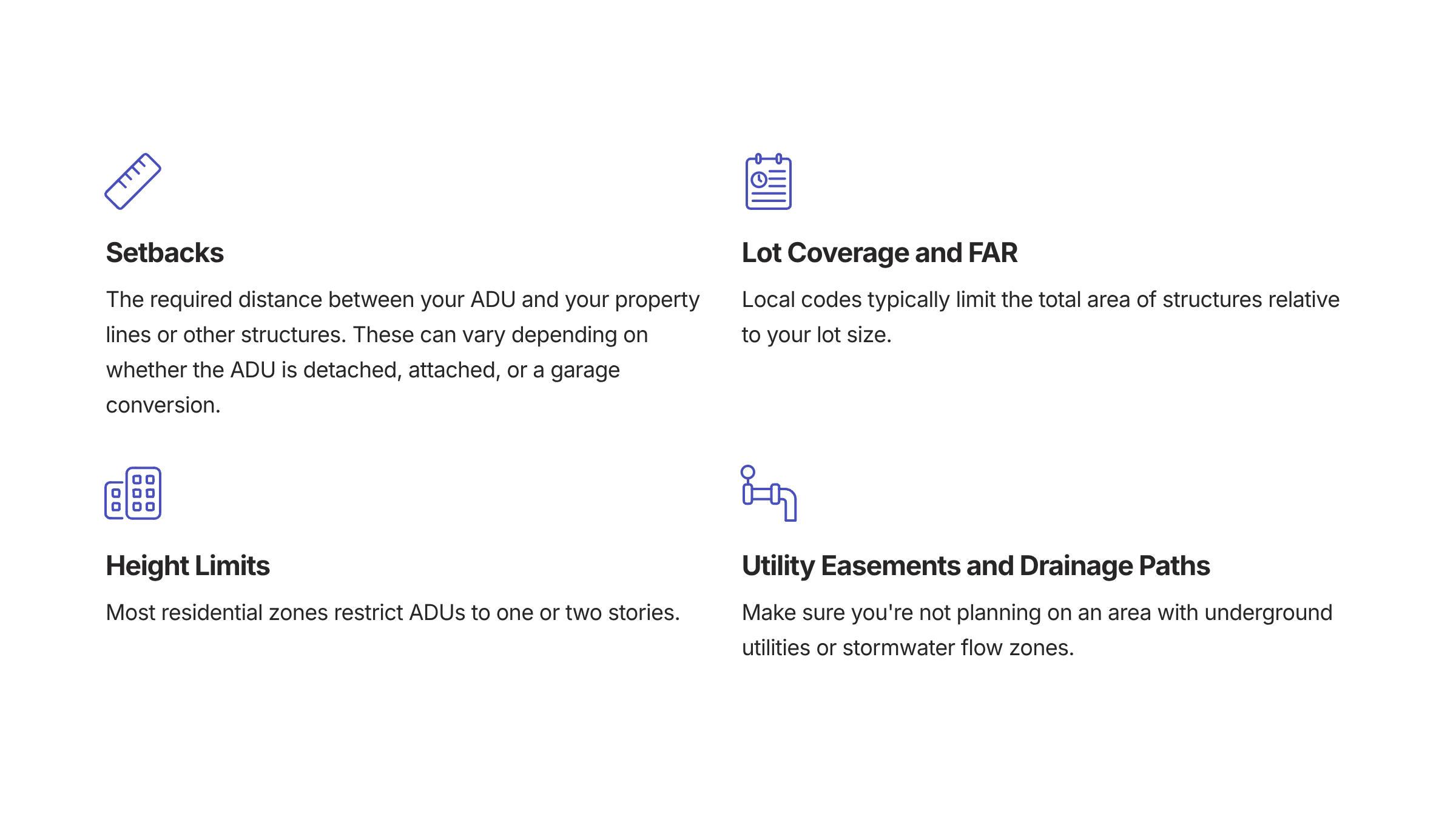
Setbacks determine how far your ADU must be from property lines, the main home, and adjacent structures. This is one of the most misunderstood aspects of ADU planning, and mistakes here are expensive.
Most Colorado municipalities require at least 5 feet from rear and side property lines. Some require more. Height limits for detached ADUs typically fall between 24 and 30 feet. Some cities also impose a minimum separation between the ADU and the primary residence. In Denver, ADUs must generally be located within the rear 35% of the lot.
We cover this in detail — with city-by-city breakdowns, setback diagrams, and lot coverage calculations — in our Colorado ADU setback requirements guide. Read it before you draw a single layout.
3. Access
Every ADU needs safe, legal access for occupants, utility providers, and emergency services. Work through this checklist:
- Separate entrance: Most cities require the ADU to have its own private exterior entrance, independent of the main home.
- Pedestrian path: How do tenants reach the unit — through the backyard, a side pathway, from the alley? Is that path well-lit and accessible year-round?
- Parking: Many Front Range municipalities have waived parking requirements for ADUs near transit corridors, but some still require one off-street space. Check your city's specific rule.
- Emergency vehicle access: Fire trucks need to be able to reach the unit. In practice this usually means a clear path of a certain width — your city's fire code specifies the exact requirement.
- Alley access: Denver's older residential neighborhoods are laid out with alleys between properties. If your lot fronts an alley, the ADU can often be accessed from the alley with a separate address, which simplifies things considerably. Note: if your ADU will front an alley, Denver's code has specific rules about garage door setbacks and visibility triangles — know these before you design.
4. HOA Rules
Your city may say yes. Your HOA might say no. These are independent constraints and both apply.
Some HOAs prohibit secondary structures entirely. Others restrict short-term rental use, require the ADU to architecturally match the main home (roofline, exterior materials, paint palette), or impose rules around utility hookups and landscaping. If your neighborhood has an HOA, read the CC&Rs before anything else.
What Does a Prefab ADU Cost in Colorado?

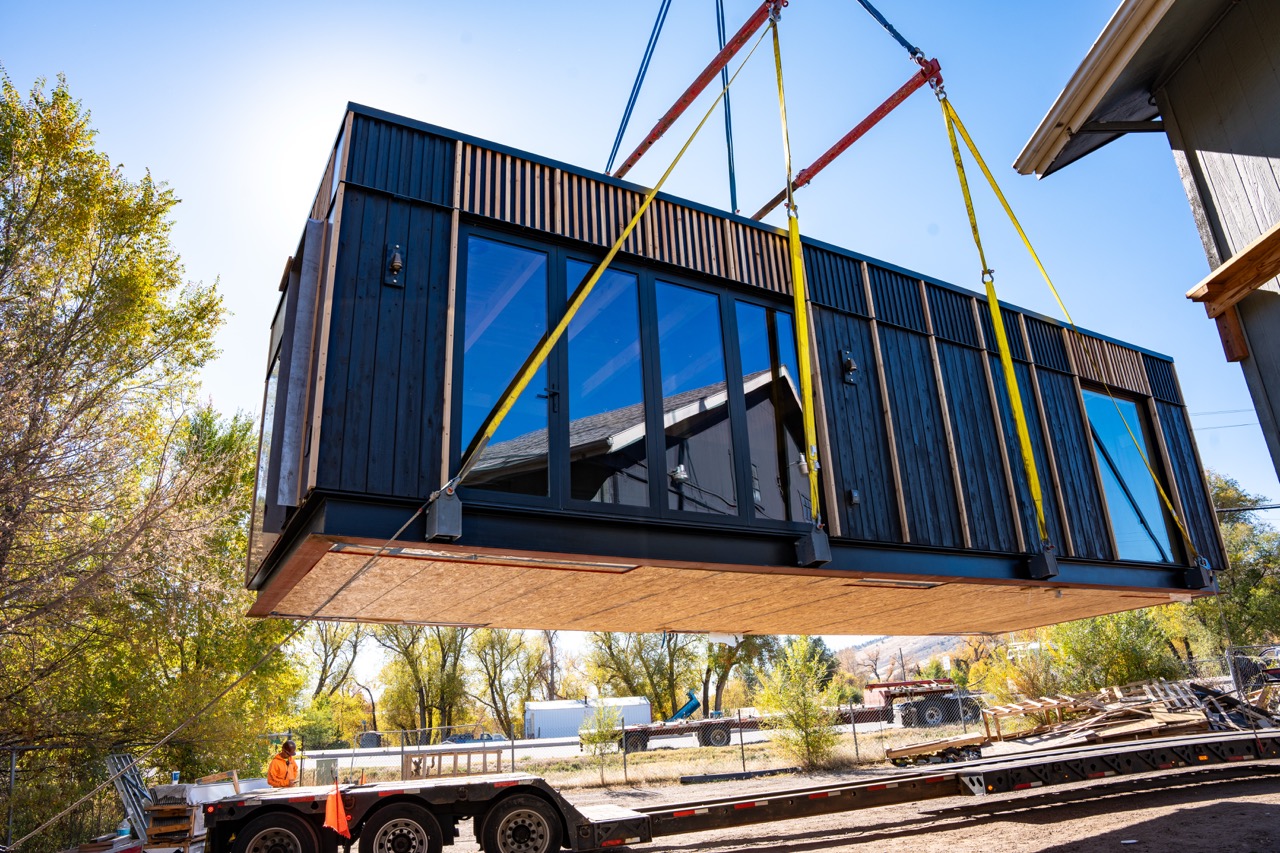
Base price is the unit itself — designed, built, and delivered from our Lyons workshop.
Turnkey is everything: the unit plus permits, structural and soils engineering, energy compliance documentation, foundation design and construction, utility connections, crane delivery, installation, project management, final inspections, and handover. The number you're quoted is the number you pay.
That fixed pricing matters. Traditional ADU construction projects routinely run 20–40% over initial estimates. Weather delays, subcontractor scheduling gaps, materials changing in price mid-project — cost overruns in on-site construction aren't a failure of honesty, they're how the process works. Fixed pricing means you know the total before you start.
What Drives the Gap Between Base and Turnkey?
The roughly $80,000 between base and turnkey reflects real site variables:
- Utility connections — extending water, sewer, and electrical from the main house or street. Simple connections on flat urban lots cost less than running lines across sloped or infrastructure-limited properties.
- Foundation complexity — a standard slab on a flat lot is fast and cost-effective. Expansive soils, steep grades, or rocky terrain requires more engineered work.
- Site access — can a crane reach your backyard cleanly? Does a fence or gate need to move? Is there alley access? These details affect how installation day goes.
Prefab vs. Stick-Built: The Complete Comparison

For a deeper look at which method makes sense for different sites and buyers, see our modular vs. stick-built guide.
What You Can Do With an ADU in Colorado
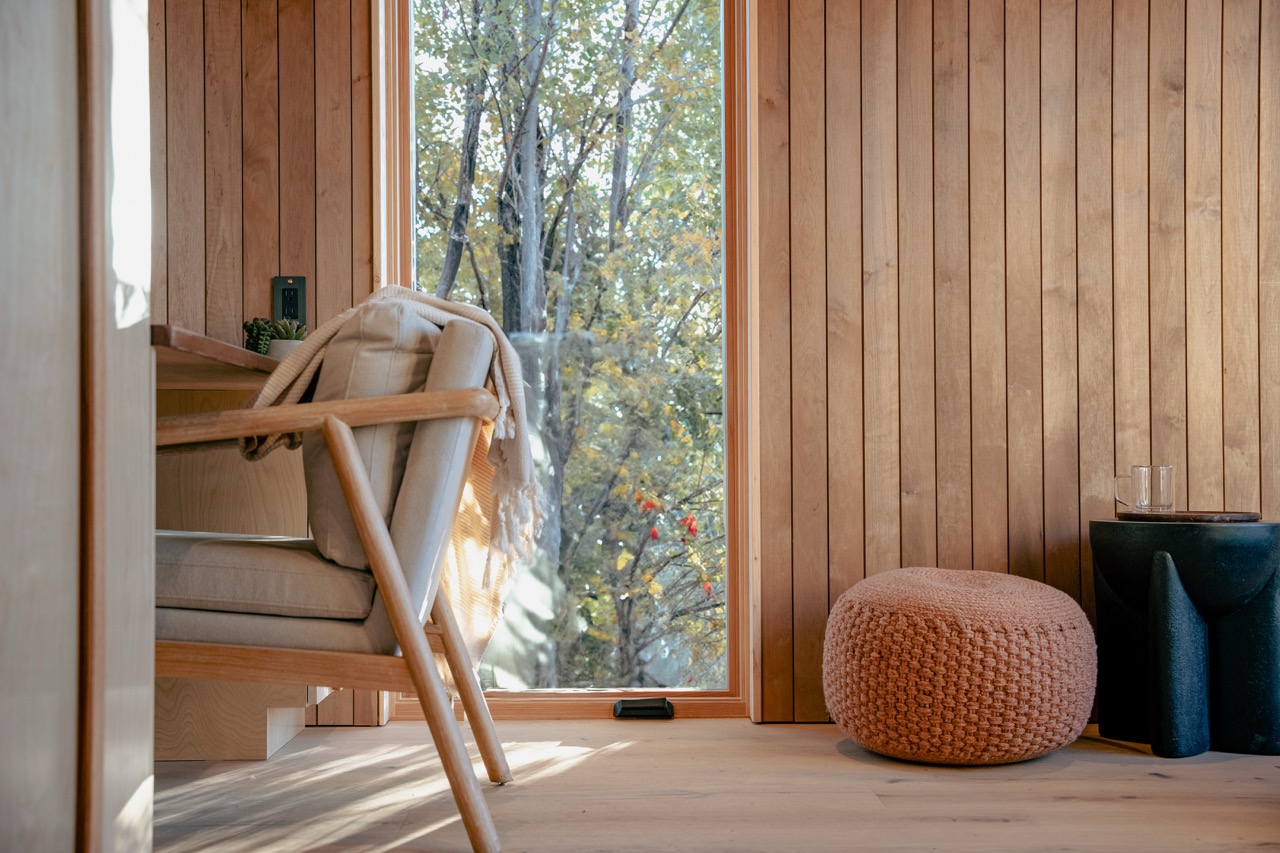
Different homeowners come to ADUs for different reasons. The right model — Shelter Studio Flex, Shelter 1 Bedroom, or Shelter 2 Bedroom — depends on which category you're in.
Long-term rental income is the most common driver. A well-finished detached 1-bedroom ADU in Denver generates $1,800–$3,000/month in long-term rent. Boulder commands similar or higher. A studio in a walkable Denver neighborhood typically pulls $1,500–$2,200/month. At those rates, against HELOC financing on a Shelter 1 Bedroom, many homeowners are cash-flow positive from the first month. ADU-equipped properties also tend to sell for 20–30% more than comparable homes without them.
Short-term rental offers higher income potential in the right location, but more operational complexity and local licensing requirements. Denver requires an STR license and restricts short-term rentals to owner-occupied properties. Boulder has its own rules. Mountain towns with strong tourism traffic can generate solid nightly rates. Always confirm your city's STR regulations before designing around this model.
Multi-generational living — aging parents who want independence without distance. Adult children who need a real landing pad that isn't your living room. Families who want to stay close without sharing walls. A detached Shelter gives everyone their own front door and their own life.
Home office or studio — a properly insulated, dedicated workspace 20 steps from the back door is a fundamentally different thing from a desk in the corner of a bedroom. For remote workers, architects, therapists, trainers, or anyone who needs real separation, this use case justifies the investment without any rental income at all.
Vacation rental or creative workspace — if your property is in a tourist-accessible area, or in a neighborhood with demand for creative workspace, the unit can serve as a hybrid of personal use and income generation.
Assisted housing programs — Denver's ADU Pilot Program and Boulder's Affordable ADU Program both provide support for homeowners who rent at below-market rates, including design assistance, permitting help, and in some cases grants. If this aligns with your values and finances, it can reduce build costs while contributing to your community's housing supply.
For a full breakdown of the financial return — rental market data by city, size decisions, long-term property value impact — see our ADU ROI guide for Colorado homeowners.
Colorado ADU Rules: City-by-City Snapshot
Rules vary more than most homeowners realize. Here's a working snapshot of the major Front Range municipalities. Always verify current rules with your local planning department before committing to a design.
For diagrams, lot coverage calculations, and the full city-by-city breakdown, see our Colorado ADU setback requirements guide.
How to Finance a Prefab ADU in Colorado
More accessible than most homeowners expect — especially if you've been in your home for a few years and built equity.
Home Equity Line of Credit (HELOC) The most widely used tool for ADU financing. You borrow against the equity in your primary home — typically up to 80–85% of appraised value minus your outstanding mortgage balance — and draw from it as the project progresses. HELOCs are approved readily for ADU construction because lenders classify it as a property improvement. Rates are variable. ELMNTL works with financing partners to streamline pre-qualification — soft credit pull only, no score impact.
Home Equity Loan (HEL) Same equity basis, but structured as a lump sum at a fixed rate with a fixed repayment schedule. Better for homeowners who want predictable monthly payments from day one. Less flexible if actual costs vary.
Cash-Out Refinancing Refinance your existing mortgage at a higher loan amount and take the difference as cash. Makes sense if you have significant equity and current rates are close to your existing mortgage rate. Less attractive when rates are high.
Construction Loan Short-term financing covering the build, typically converted to a permanent mortgage at completion. More paperwork and higher fees than a HELOC. Usually best for larger or more complex projects where a HELOC doesn't cover the full amount.
Colorado Grant and Assistance Programs
- Denver ADU Pilot Program — design and permitting support, potential grants for below-market rentals. Active in 2026.
- Boulder Affordable ADU Program — support for homeowners who rent at below-market rates.
- Colorado DOLA ADU Grant Program — DOLA's Accessory Dwelling Unit Grant Program (ADUG) is available to ADU-Supportive Jurisdictions (those that have certified compliance with HB 24-1152). Round 2 application deadline is March 18, 2026. This is a real funding source worth investigating if your municipality has achieved ADU-Supportive certification.
- CHFA ADU Finance Programs — Colorado Housing and Finance Authority offers ADU-specific financing programs accessible through ADU-Supportive Jurisdictions.
For a complete breakdown of every option, Colorado-specific programs, what questions to ask your lender, and how to prepare your application, see our ADU financing guide for Colorado homeowners.
Design Yours Today
Most ADU quotes start with a phone call and end with a number that doesn't mean much until you're three months into the process. ELMNTL's configurator works differently. In a few minutes, you can choose your model, pick your exterior finish — from Corten steel to single-origin Japanese cedar — select an interior theme, stack on add-ons like a rooftop deck, attached sauna, or solar system, and get a real estimate sent straight to your inbox. No call required.

It's useful before you're ready to commit, too. Running the configurator is the fastest way to understand the relationship between what you want and what it costs — before you've talked to a lender, engaged a contractor, or made any decisions you can't walk back.
Frequently Asked Questions
Are prefab ADUs legal in Colorado? Yes. Legal throughout Colorado provided they meet local building codes and zoning requirements. Most municipalities treat prefab ADUs identically to site-built ones. ELMNTL handles all permitting and compliance, with a permit approval guarantee.
What did HB 24-1152 actually change? It eliminated minimum lot size requirements for ADUs in most Colorado residential zones and required subject jurisdictions — which covers the entire Front Range — to allow ADUs by right in all single-family zones. It went into effect June 30, 2025.
How long does it take to build a prefab ADU? With ELMNTL, approximately 7 months from contract to keys — covering design, permitting, factory manufacturing, and installation. Site-built ADUs typically run 10–16 months.
Do I need to live on the property? Depends on your city. Denver removed its owner-occupancy requirement for long-term rentals in December 2024, but maintains it for short-term rentals. Other municipalities vary. Confirm before finalizing your rental or occupancy plans.
What are the size limits for ADUs in Colorado? Most municipalities cap detached ADUs at 1,000–1,200 sq ft, or at a percentage of the primary home's floor area. ELMNTL's units (420–714 sq ft) fall well within the allowable range in virtually every jurisdiction we build in.
Do I need a separate utility connection for my ADU? Depends on local code. Some cities allow shared utilities. Others require separate water, sewer, and electrical connections — which adds cost. Your feasibility review will clarify what applies to your specific property and municipality.
Can I put my ADU on Airbnb? Depends where you are. Denver requires an STR license and restricts short-term rentals to owner-occupied properties. Boulder has its own licensing structure. Mountain towns vary. Always confirm local STR regulations before building around this model.
Will an ADU raise my property taxes? Yes — adding a structure increases your assessed value and your annual tax bill. The increase is typically modest relative to rental income and long-term property value gains. Properties with ADUs can sell for 20–30% more than comparable homes without them.
What if my lot is sloped or has unusual soil conditions? That's exactly what the feasibility review is for. We've built on flat Denver lots, sloped Boulder hillsides, and sites with expansive soils. Unusual conditions change the foundation approach and sometimes the utility connection strategy — they rarely make a build impossible.
Can prefab ADUs get financing? Do lenders treat them differently? ELMNTL units are permanently affixed to their foundations and appraised as standard real property. Lenders treat them the same as stick-built construction. We provide all required documentation to support your lender's review. We haven't had a financing failure related to build type.
What does ELMNTL's permit guarantee mean? If we submit for permits and approval isn't granted, you receive a full refund. We back this with the experience of having done this across dozens of Colorado municipalities. It's not a marketing claim — it's a promise we've built a process to keep.
Does DOLA's new ADU grant apply to my project? Potentially. The Colorado DOLA Accessory Dwelling Unit Grant Program (ADUG) is available through ADU-Supportive Jurisdictions — municipalities that have achieved certification under HB 24-1152. If your city is ADU-Supportive certified, CHFA ADU finance programs also become accessible. Check with DOLA's Division of Local Government portal for current participating jurisdictions.




.jpg)