
Modular Homes in Colorado: Costs, Builders & What to Expect (2026)
What are modular homes in Colorado?
Modular homes in Colorado are factory-built structures constructed to the same International Residential Code (IRC) as any site-built home, then transported to your land and set on a permanent foundation. They are regulated by the Colorado Division of Housing and are legally classified as real property. That means conventional mortgages, standard appraisals, and appreciation in line with the local market.
The term gets used loosely. "Modular" is not the same as "manufactured" or "mobile." Manufactured homes are built to federal HUD code and can be titled as personal property. Modular homes are built to IRC and must sit on a permanent foundation. Colorado's Division of Housing regulates both, but under separate frameworks. The distinction matters for financing, resale, and long-term value.
In Colorado's mountain markets specifically, modular construction has gained ground for reasons that go beyond cost. Factory builds are not subject to high-altitude weather windows, contractor scarcity, or the remote-access penalties that inflate site-built budgets in Summit, Park, and Clear Creek counties. The unit is completed in a controlled facility while your site is being prepared. The two processes run in parallel rather than in sequence.
For buyers who already own mountain land — and for Front Range homeowners looking to build a second home 60 to 90 minutes from Denver — modular construction in Colorado offers a path that is faster, more predictable, and increasingly design-forward compared to a decade ag
This guide lays out the complete cost of building a modular home in Colorado: the unit, the site work, the permits, and the variables that shift the total when you're building on mountain land.
Three modular myths worth clearing up first
Do modular homes use lower-quality materials?
It was truer in the past. The volume modular market of the 1980s and 90s leaned heavily on synthetic materials — spray foam, vinyl windows, composite cladding — because they were fast and cheap. That reputation has been slow to update.
Today the market is more varied. At the lower end, the description still holds. But a growing segment of precision manufacturers — particularly those building for mountain second-home buyers — specifies natural insulation materials, premium window systems, and construction tolerances that are difficult to achieve in a site-built environment. Factory construction, done well, enables more consistency than a site-built project managed across a fragmented network of subcontractors.

Will banks finance a modular home?
Manufactured homes (sometimes called HUD homes or mobile homes) are built to federal HUD code, can be titled as personal property, and carry certain financing limitations. Modular homes are built to the same International Residential Code (IRC) as site-built homes, are permanently affixed to a foundation, and are titled and appraised as real property. Colorado's Division of Housing regulates both categories separately. Modular homes qualify for conventional 30-year mortgages, construction-to-permanent loans, and cash-out refinancing on the same basis as any site-built home.
Do modular homes hold their value?
A modular home built to IRC code, set on a permanent foundation, and appraised as real property appreciates in line with the local market — the same as any comparable home in the neighborhood. In Colorado's mountain markets, where land values have appreciated significantly over the past decade, a well-built permanent structure on a desirable parcel is a real asset. The depreciation concern applies to HUD-code manufactured homes — a different product category entirely.
Why the mountains of Colorado changes how we think about modular homes
Building on mountain land in Colorado means meeting some of the most demanding residential structural standards in the country. These are county-enforced requirements, not optional upgrades. A modular home that doesn't meet them will not receive a certificate of occupancy.
- Roof snow load: Summit County requires a minimum 100 pounds per square foot (psf). Pitkin (Aspen area) and Park counties have comparable requirements — significantly above the national baseline of 20–30 psf.
- Wind exposure: Ridge-exposed sites along the Front Range and at elevation face wind loads that require engineered structural systems. Exposure Category D requirements are common in open mountain terrain.
- Fire rating: Colorado's wildland-urban interface (WUI) now covers large portions of the foothills and mountain communities. New construction in WUI zones increasingly requires Class A fire-rated assemblies for roofing, cladding, and venting.
- Foundation: Under Colorado Division of Housing rules, modular homes must be installed on permanent foundations. Foundation design must be certified by a Colorado-registered design professional in jurisdictions without a local building department.
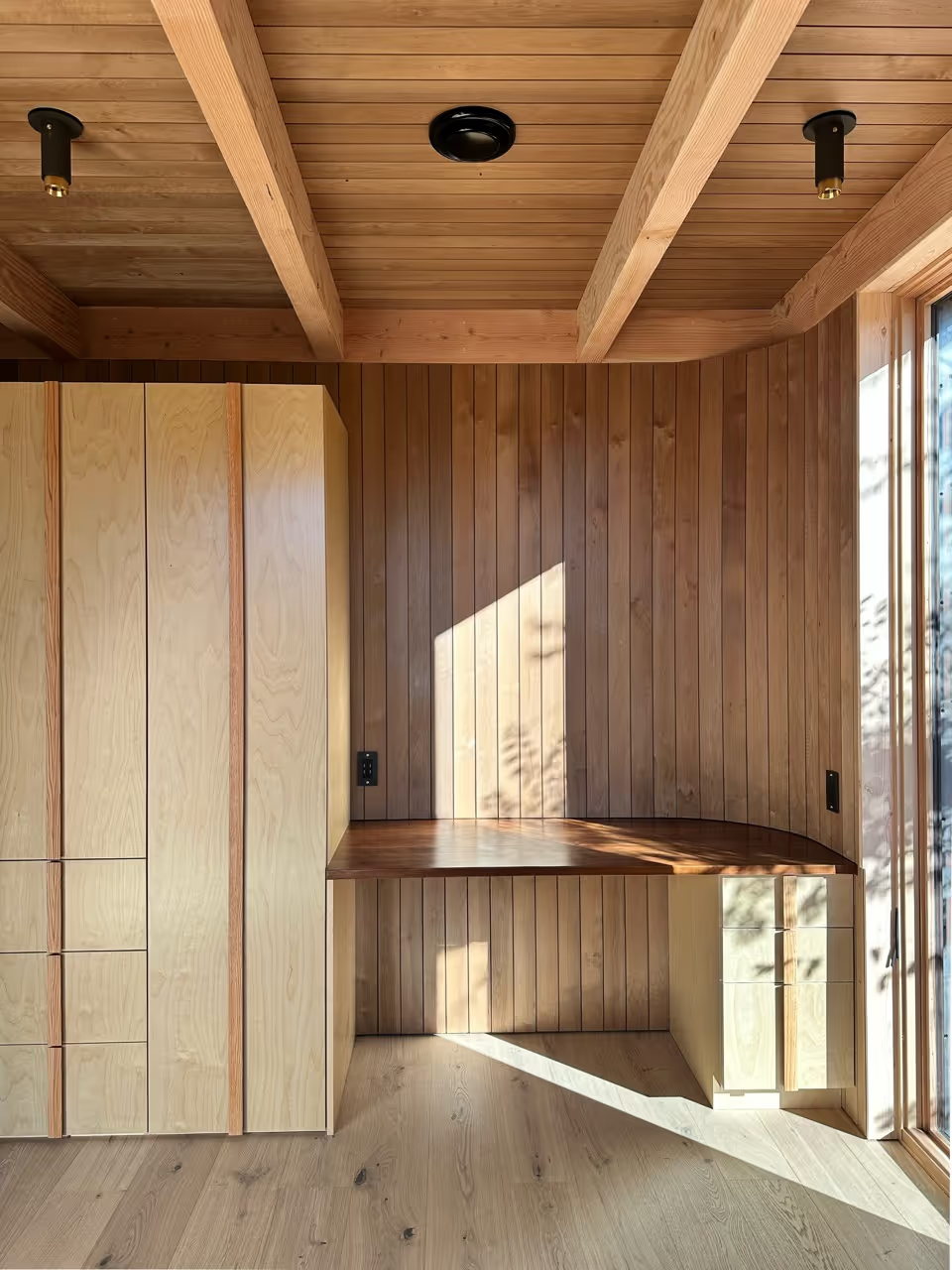
A useful proxy for genuine mountain experience: ask which Colorado counties the manufacturer has completed projects in. Summit, Park, Clear Creek, Pitkin, and Teller are the hard cases. A builder with completed permits in those jurisdictions has already navigated the requirements.
How to choose a modular home builder in Colorado
The modular home market in Colorado ranges from volume manufactured housing companies to a smaller group of precision builders focused on mountain second homes and design-forward residential construction. The segment you're buying from determines the materials, structural specifications, and level of service you can expect — and the price points are meaningfully different.
Ask about Colorado-specific structural experience first. Mountain county building departments enforce some of the most demanding residential structural requirements in the country — 100 psf snow loads in Summit County, wind exposure requirements for ridge-exposed sites, and Class A fire assemblies in WUI zones across the foothills. A builder without completed permits in Colorado mountain counties is learning on your project. Ask for permit numbers in Summit, Park, Clear Creek, or Pitkin counties. A builder with a track record in those jurisdictions has already navigated the requirements.
Understand what is included in the price. Most modular manufacturers in Colorado advertise a base unit price that does not include foundation work, site preparation, utility connections, or permits. The gap between base price and turnkey cost on a mountain parcel is typically $60,000–$100,000. Ask every builder for a turnkey price — covering feasibility, engineering, permitting, site work, delivery, crane set, utility connection, and final inspection — not just the unit cost off the factory floor.
Look for a fixed price, not an estimate. A reputable Colorado modular home builder should conduct a full site feasibility assessment before confirming a turnkey price. That assessment covers land access for delivery, zoning compliance, setback requirements, utility connections, and foundation conditions. Once completed, the price should be fixed in writing. If a builder gives you a firm number before seeing your land, treat it as a starting point, not a commitment.
Verify the manufacturer's state license. Colorado-built modular homes must be constructed under a Division of Housing manufacturing license. Ask for the license number and verify it at doh.colorado.gov.
What modular homes cost in Colorado — the full picture, with pricing
Building costs vary significantly across the U.S., driven by local labor markets, material availability, regulatory requirements, and site conditions. Colorado consistently sits above the national average — and mountain communities like Summit County and the Roaring Fork Valley push costs higher still, reflecting the realities of high-altitude construction, stricter structural requirements, and limited contractor access.
Base price vs. turnkey price — the most important distinction
Base price covers the unit as manufactured, delivered, and craned onto a prepared foundation. It does not include foundation work, site preparation, utility connections, or permits.
Turnkey price covers everything: feasibility assessment, zoning review, structural engineering, permitting, site work coordination, delivery, crane set, utility connection, and final inspection. On a mountain lot, the gap between base and turnkey can be $60,000–$100,000.
Most modular manufacturers only advertise the base price. This makes comparison nearly impossible for buyers and consistently leads to budget surprises. The table below shows ELMNTL's current pricing as a concrete reference point for the Colorado premium modular market.

Once a site feasibility assessment is complete and a turnkey price is confirmed, that number should not change. Any reputable manufacturer should be willing to put a fixed price in writing after assessing your specific site — not before. If a builder gives you a fixed turnkey price without formally assessing your land, treat it as an estimate, not a commitment.
Site work on mountain land: the honest variable
Turnkey prices include site work coordination, but site work costs themselves vary with your specific land. This is the one genuinely unpredictable element of any mountain build.
Slope and terrain
A flat, cleared lot with utility connections nearby is the baseline. Site work in these conditions typically runs $15,000–$30,000. On a challenging remote parcel above 8,000 feet with no utility access, total site costs can reach $60,000–$80,000 or more.
Well drilling
If your land doesn't have access to municipal water, budget $7,000–$20,000 or more for well drilling. Mountain wells in Colorado frequently require drilling through granite — depths of 300–600 feet are not unusual in Summit, Park, and Teller counties.
Septic systems
Mountain counties in Colorado frequently require engineered septic solutions rather than conventional gravity systems. Budget $15,000–$50,000 depending on the system required. A standard percolation test ($300–$800) reveals whether your soil will support a conventional system — the single most important test to run before committing to any mountain parcel. (Colorado Division of Housing)
What mountain construction actually costs — and why modular is different
The build season is shorter than most buyers expect
In Denver, you might get ten solid outdoor building months. In the mountains, it's closer to five. Snow arrives in October in most high-elevation communities, and mud season in April can halt foundation work for weeks. A site-built project that hits complications can stretch into a second year — a second winter, a second mud season, a second year of financing costs.
Factory construction eliminates this constraint. The unit is built in a controlled environment year-round while site preparation happens in parallel. There is no lost season.
Remote access multiplies every cost
Site-built construction in remote mountain locations means every subcontractor visit is a trip up a winding county road. Every material delivery adds freight. Every delay ripples through a fragmented chain of sub-trades charging premium mobilization rates. With modular construction, the labor-intensive work happens at a centralized facility. Your site only needs to accommodate a delivery truck and a crane — once.
Fixed pricing matters most where surprises are most expensive
Colorado custom stick-built homes range from $275–$500 per square foot in 2025 — and mountain builds routinely run 20–40% over original budget due to weather delays, contractor scarcity, and change orders. The most damaging dynamic isn't the cost per square foot — it's the change order spiral. Unexpected rock outcroppings. Soil conditions requiring engineered foundations. Utilities further from the structure than anticipated. Each surprise adds cost to an already fragmented project.
Financing a modular home in Colorado
Because modular homes are classified as real property under Colorado law — permanently affixed to a foundation, built to IRC code, and appraised as real estate — they qualify for the same financing products available on any conventional home.
- Construction-to-permanent loan: Covers the build phase at a floating rate, then converts to a fixed 30-year mortgage on completion. Most common for buyers building on raw land purchased separately.
- HELOC or cash-out refinance: For buyers with existing home equity, often the fastest and most flexible path — particularly for mountain second homes where construction financing can be complex.
- Conventional 30-year mortgage: Available once the home is complete, appraised, and titled. Used when the buyer finances the build with cash or a bridge loan and places permanent financing at completion.
For context: a $379,000 modular home with 20% down, financed over 30 years at a current conventional rate, carries a principal and interest payment in the range of $1,800–$2,100 per month. A comparable one-bedroom mountain cabin rental near Breckenridge or Estes Park runs $3,500–$6,000 per month during peak season.
The one test to run before committing to any mountain land
Before signing anything — with any builder, on any parcel — spend $300–$800 on a percolation test and soils assessment on your intended site.
This test tells you whether your land can support a conventional septic system, whether the soil is stable for a standard foundation, and whether you're building on bedrock that will require blasting. In mountain Colorado, the percolation test determines whether your site work budget is $25,000 or $70,000.
Any reputable modular manufacturer should conduct a full site feasibility assessment before quoting a fixed price — covering buildability, access for delivery, zoning compliance, utility requirements, and setbacks. If a builder quotes you a fixed turnkey price before doing this work, that price is a guess.
Frequently asked questions
How much does a modular home cost in Colorado?
A turnkey modular home in Colorado typically ranges from around $278,000 for a compact studio (roughly 420 sq ft) to $449,000 for a two-bedroom model (around 714 sq ft). National averages of $80–$160 per square foot reflect base unit costs only and exclude site work, which on mountain land can add $30,000–$80,000 or more. Always ask for the full turnkey price, not just the base unit cost.
What is the difference between a modular home and a manufactured (HUD) home?
Modular homes are built to the IRC — the same standard as a site-built home — and must be installed on a permanent foundation. They are titled as real property and qualify for conventional mortgages. Manufactured (HUD-code) homes are built to federal HUD standards, can be titled as personal property, and carry different financing rules. Colorado's Division of Housing regulates both separately. The two are legally and structurally different products.
What does site work cost for a modular home on mountain land in Colorado?
Site work is the biggest variable. On a flat, accessible lot with utilities nearby, expect $15,000–$30,000. On a steep, remote parcel above 8,000 feet requiring well drilling, engineered septic, and significant excavation, costs can reach $60,000–$80,000 or more. Run a percolation test ($300–$800) before committing to any parcel.
Is a modular home cheaper than stick-built in Colorado?
Not always cheaper per square foot, but often more predictable in total cost. Custom stick-built construction in Colorado mountain communities runs $275–$500 per square foot in 2025. The stronger case for modular is a fixed price after a thorough site assessment, compressed timeline, and factory-controlled quality that removes a significant category of cost and schedule risk.
How long does it take to build a modular home in Colorado?
Most modular home projects run four to seven months from contract to occupancy. Factory construction runs regardless of mountain weather while site preparation happens simultaneously — eliminating the lost seasons that push site-built mountain projects into second years.
Can I build a modular home on raw land in Colorado?
Yes — provided the land can support a permanent foundation, is accessible for delivery, meets local zoning requirements, and can accommodate a septic system if not on municipal sewer. A site feasibility assessment should be completed before committing to any builder or price.
Do modular homes hold their value in Colorado?
Yes. Modular homes built to IRC code on a permanent foundation are appraised and financed as real property and appreciate in line with the local market. This is distinct from HUD-code manufactured homes. In Colorado's mountain markets, a well-built permanent structure on a desirable parcel behaves like any other real asset.
Which Colorado counties are most common for modular home permits?
Modular homes have been permitted across Colorado, including Front Range counties (Jefferson, Larimer, Boulder, El Paso) and mountain counties (Summit, Park, Clear Creek, Pitkin, Teller). Mountain county permits require structural specifications for local snow loads, wind exposure, and — in WUI zones — fire resistance. Ask any builder to name specific completed projects in Summit or Park County and ask to see the permit numbers.
Are modular homes allowed in Colorado?
Yes. Modular homes are legal in all 64 Colorado counties, regulated by the Colorado Division of Housing under Colorado Revised Statutes 24-32-3301 et seq. Manufacturers must submit plans for DOH approval before construction and display the DOH insignia on each completed unit. Local governments can impose geographic and climatic requirements — snow loads, wind, fire — but cannot adopt standards less stringent than state minimums.
Is it cheaper to build or buy a home in Colorado?
In most Colorado markets in 2025, buying an existing home is faster and typically less expensive than building from scratch. Building makes the most sense when you already own land, need a home built to specific mountain structural requirements, or can't find an existing property that meets your needs. For buyers with mountain land and a specific vision — a permanent second home engineered for high-elevation conditions — building modular can offer a more predictable path.
Sources
- Colorado Division of Housing — Factory Built Structures & FAQ: Modulars
- NAHB — Cost of Constructing a Home, 2024
- Home-Cost.com — Construction Cost Per Square Foot by State
- NAHB Eye on Housing — Square Foot Prices Moderate in 2024
- Sidney Aulds Building Studio — 2025 Colorado Construction Costs
- SDB Denver — How Much Does It Cost to Build a House in Denver
- Gowler Homes — FAQs — Colorado Custom Home Costs 2025
- McSwain Builders — Cost of Building in Roaring Fork Valley, Colorado
- HomeAdvisor / Angi — Cost to Build a Modular Home (2026)
- Prefab Review — Modular Home Companies in Colorado (March 2025)



.jpg)